Chateau Latour – ‘Views of a Legend’
In late December 2024 I packed my van and set off on a long drive to Bordeaux. A month earlier I had received a phone call from a creative director asking me if I would consider a proposal: Artemis Domaines would invite me to their Médoc vineyard – Chateau Latour – where I would make a series of images to be used in a bespoke publication about the art and craft of winemaking.
The owner of Artemis Domaines, Francois Pinault, is a renowned art collector and founder of The Pinault Collection housed in the Palazzo Grassi, Venice. Given Pinault’s love for art and wine, the remit of the photo essay was to mix the two worlds; to view winemaking through an artistic lens. This undertaking was not viewed as a commission so much as a short-term artist residency – no shot list of pretty views or commercial images. Instead it was to be my creative response to the Chateau Latour estate.
Artemis Domaines owns eight vineyards encompassing Bordeaux, Burgundy, The Rhône Valley, Champagne, California and Oregon. The Chateaux Latour estate is located in the famous Pauillac region, and was classed as one of the five first growth vineyards in the 1855 Bordeaux classification. Their premier Cru – Le Grand Vin de Chateau Latour is considered one of the worlds most age-worthy wines. The oldest document mentioning Latour dates back to 1331 when its original tower guarded the estuary. Latour spent 300 years under the control of connected families until it was finally sold in 1993 to Pinault. It has a long and rich history. Its primary terroir, known simply as L’Enclos, with its unique mix of deep gravels, sloping elevations, proximity to the semi maritime climate of the Gironde estuary all combine to make it winemaking hallowed ground.
Upon arrival I had only one sure shot in mind – the iconic tower that sits in the centre of the vineyard was the obvious headliner, outside of that I had little sense of what to expect. So it was with some trepidation that I drove down the Route Des Chateaux toward Pauillac and through the gates of Latour.
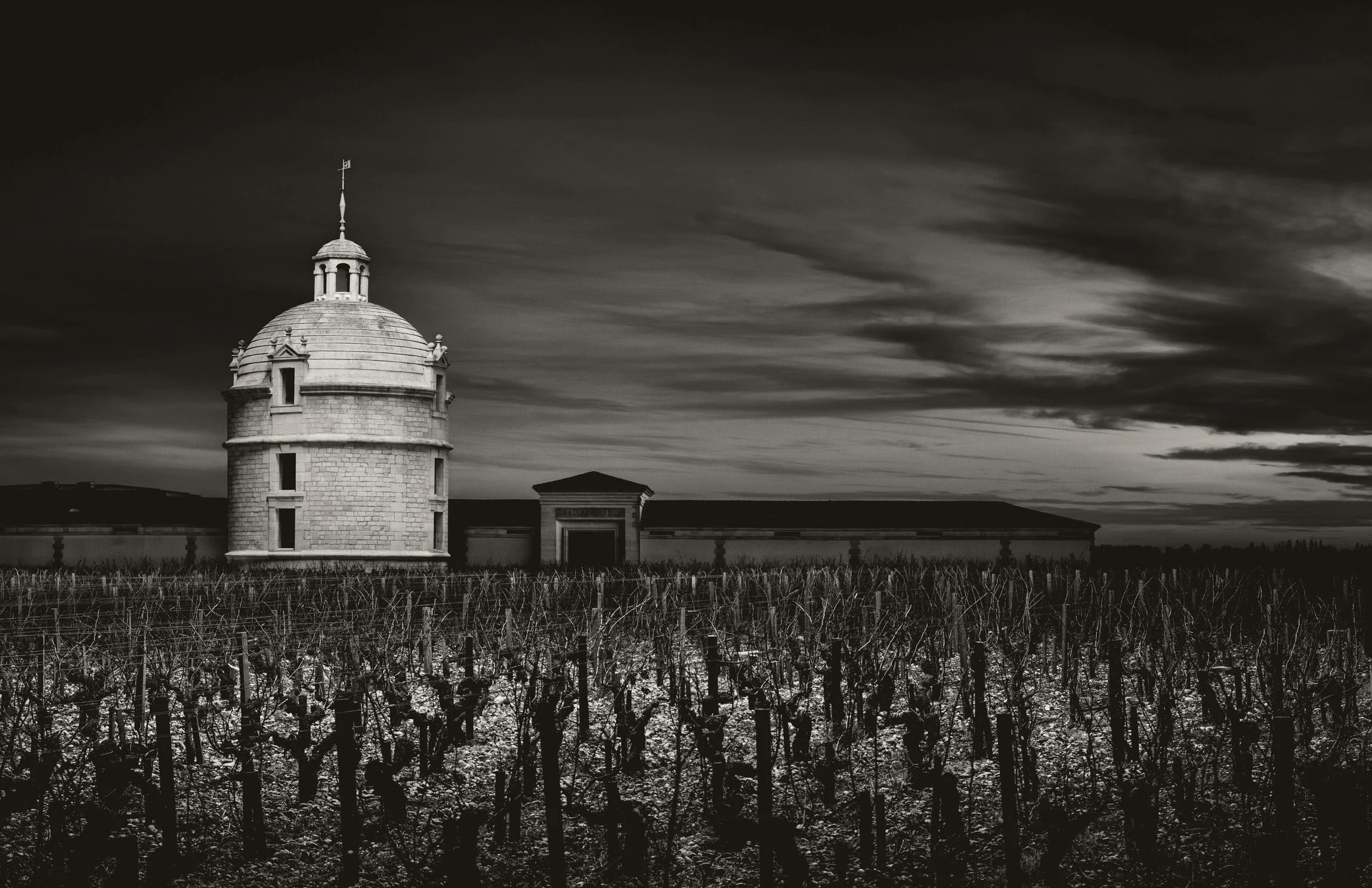
Latour’s iconic tower.
During the initial conversation about this undertaking I was asked how long I’d need. What I do is very weather dependent — lighting by drone is not be possible in strong wind or rain. Many of my images need very long exposures and wind would mean everything that can move, would move, creating motion blur. I tentatively suggested five days and prayed that the weather would stay calm. The first night, thankfully, was still and I was able to shoot the tower illuminated by drone.
Vines stretch as far as the eye can see – a bewildering, army of tendrils and gnarled stumps. I knew that they would feature heavily in my photo essay, for they’re literally the life-blood of the whole estate. In late December, with the leaves all gone, what remained were gnarled and twisted trunks, trained to grow close to the ground which reflects heat to help with ripening. From the trunks sprout tough, spindly fingers that, earlier in the season, had born their precious cargo of grapes. Pruning was just getting underway but I had arrived at the perfect moment; shorn of leaves with most of the tendrils not yet pruned, the vines bared their bones in all their skeletal glory. The more time I spent in L’Enclos the more sentient and individual the vines became – like old wizened beings that seemed to writhe as if in a slow motion dance.
I knew how I wanted shoot the vines from my experience making my Scragged Oak Hill project; I used a long exposure over the course of which I moved back and forth between the rows of vines with a large white reflector to create a blurred mist which separates subject from background. I waited, hoping for overcast conditions, but the clouds never quite got thick enough, so I went ahead and took shots in diffuse sunlight. You can see the shadows of the posts cast onto the moving reflector (below left), an effect I had not envisioned but which adds further dimension.
Cabernet Sauvignon vine of l’Enclos ⎮ Moon over the Gironde estuary
When I arrived I was given the tour. We drove around the estate in a golf cart then went underground into the depths of Latour where thousands of barrels sit maturing and precious bottles lie in temperature controlled vaults. While taking all this in, a question stayed with me: who am I – as an artist – in relation to this place? What does my ‘artistic response’ to Chateau Latour look like? The outdoor photographs felt like a known entity, echoes of images I have made before, albeit with a novel subject. Inside the winery was where the question really beckoned; could I find creativity there? My photography is so often rooted in the idea of pushing an image beyond its reality, how could I take a photograph that wasn’t simply a representation of what is?
I wandered through halls of brilliantly lit barrels, redolent with the scent of fermentation. This smell has imprinted itself in my memory. Vintners checked for sediment by the light of a candle – the old traditions are followed here.
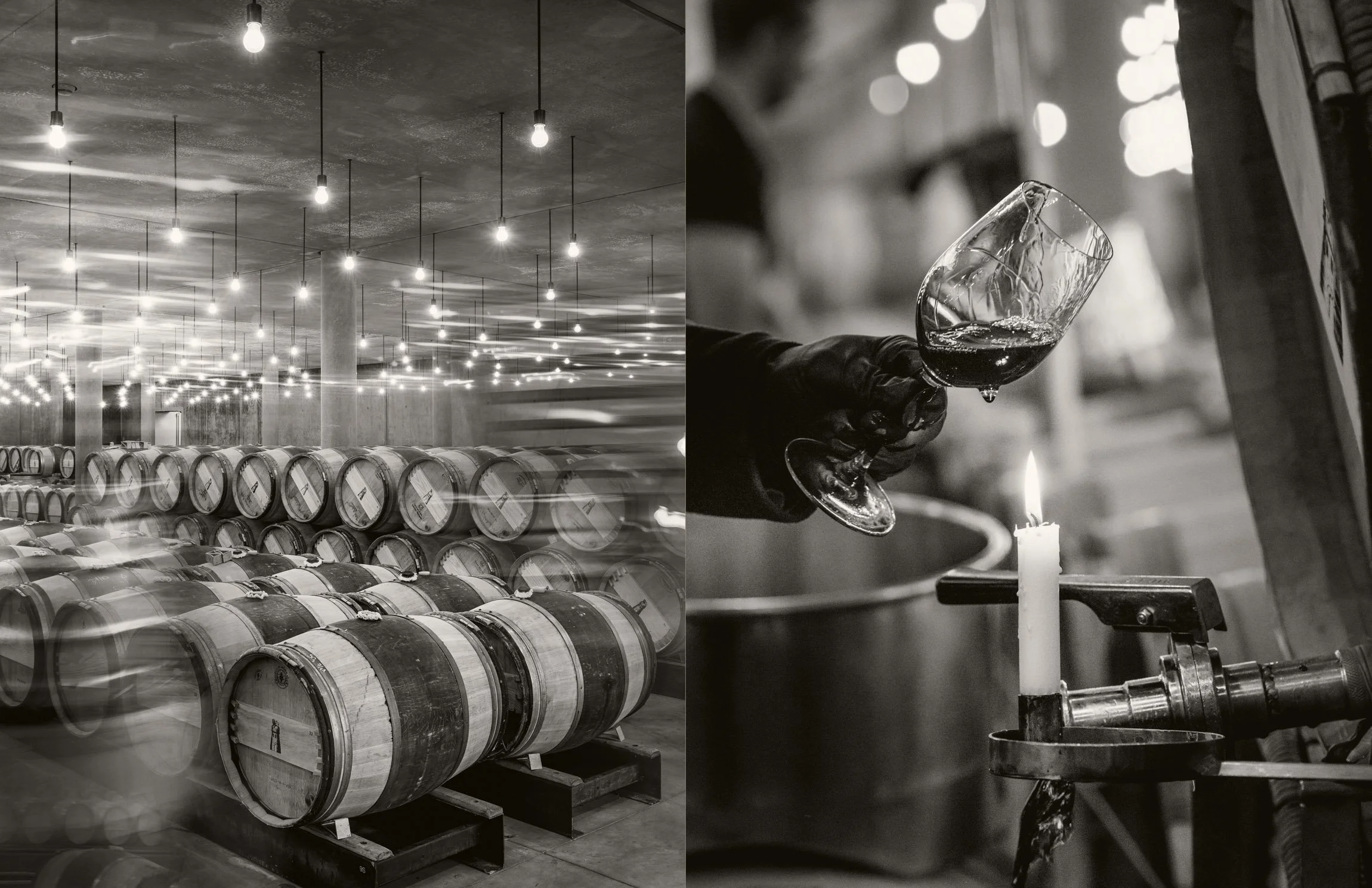
Le Grand Vin barrel aging celler ⎮ Checking for sediment using the light from a candle
On the penultimate day I enter a cellar where barrels lie in cold darkness. Up until that point all the cellars had been artfully illuminated by hundreds of hanging light bulbs, but this cellar was unlit, save for a meagre wash of light from a high window. The glimmer barely penetrated the cellar, and the rest of the cavernous space receded into blackness. Recognition dawns; a sense I know from being in a forest at night: the intrigue and uneasiness of not knowing what is beyond the torchlight. How deep was this cellar? Was anyone lingering in the dark? When light cannot penetrate, one cannot know. This feeling is familiar and yet its context is new. My question is has found an answer, and I find a part of my creative self in this place. I experiment with flash – illuminating only the first few barrels. Whilst understated, this image is my favourite from my time at Latour because it it is one that I felt answered my creative question.
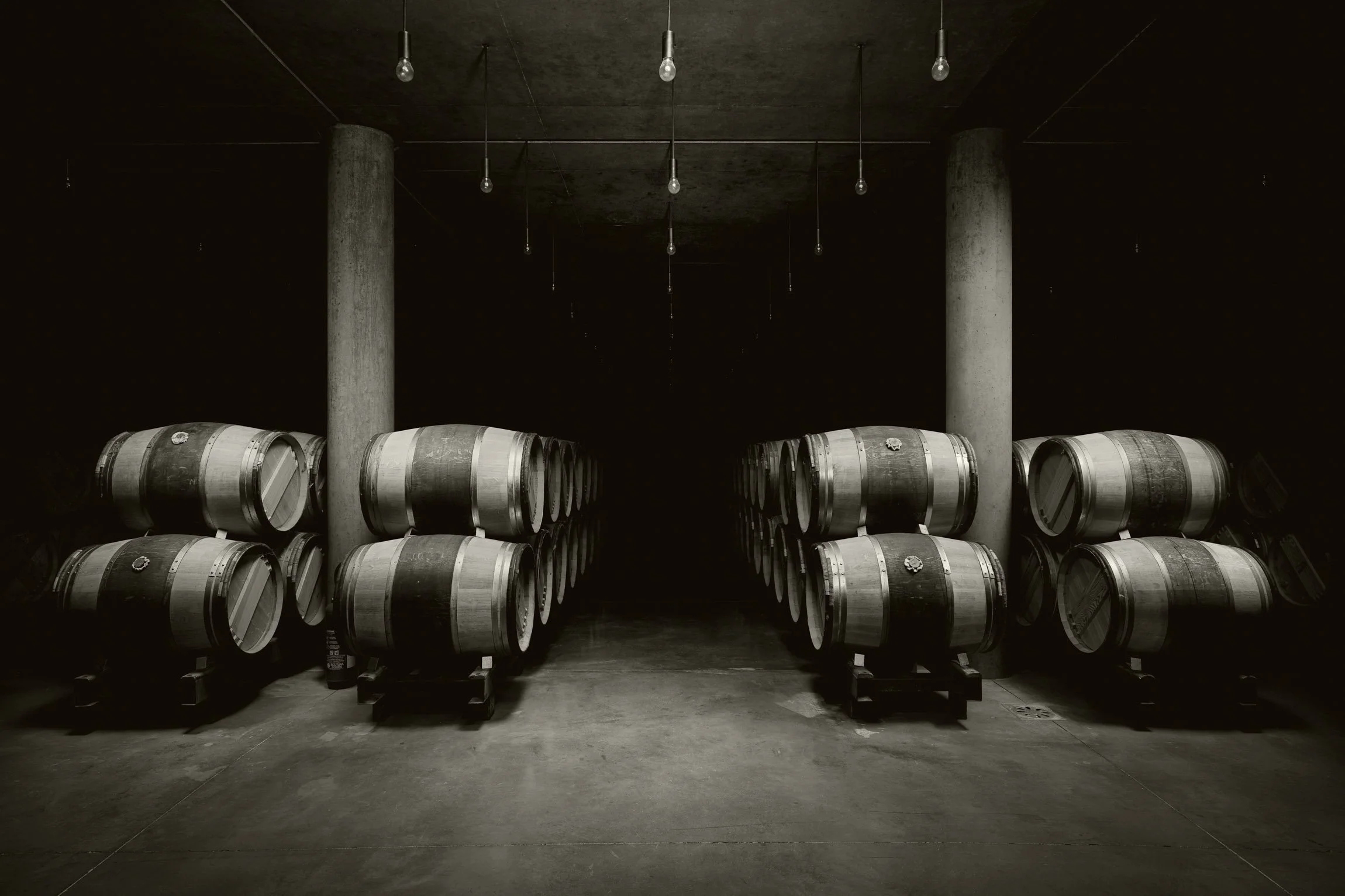
Aging cellar full of ‘Les Forts De Latour’ the second wine of the estate.
I am drawn to the relics in this place, St Vincent the patron saint of vintners stands guard in the library cellar which holds wines dating back to the 1890’s. I am allowed only a short time here so as not to disturb the delicate conditions. Bacchus, god of wine and revelry, is carved into the huge doors to the winery. Everywhere there is a sense of age and tradition.
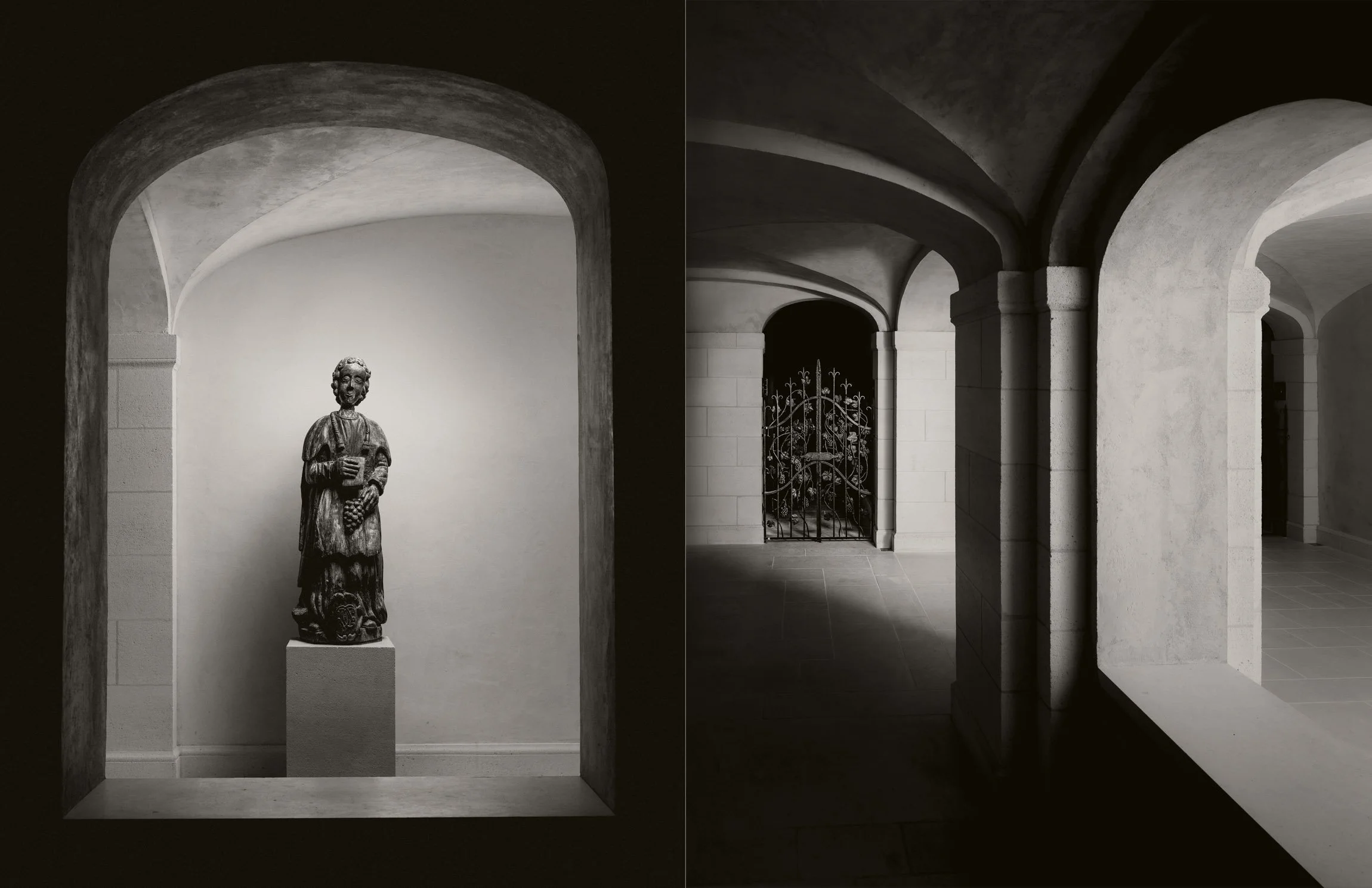
St Vincent, patron saint of Vintners ⎮ The library cellar gate
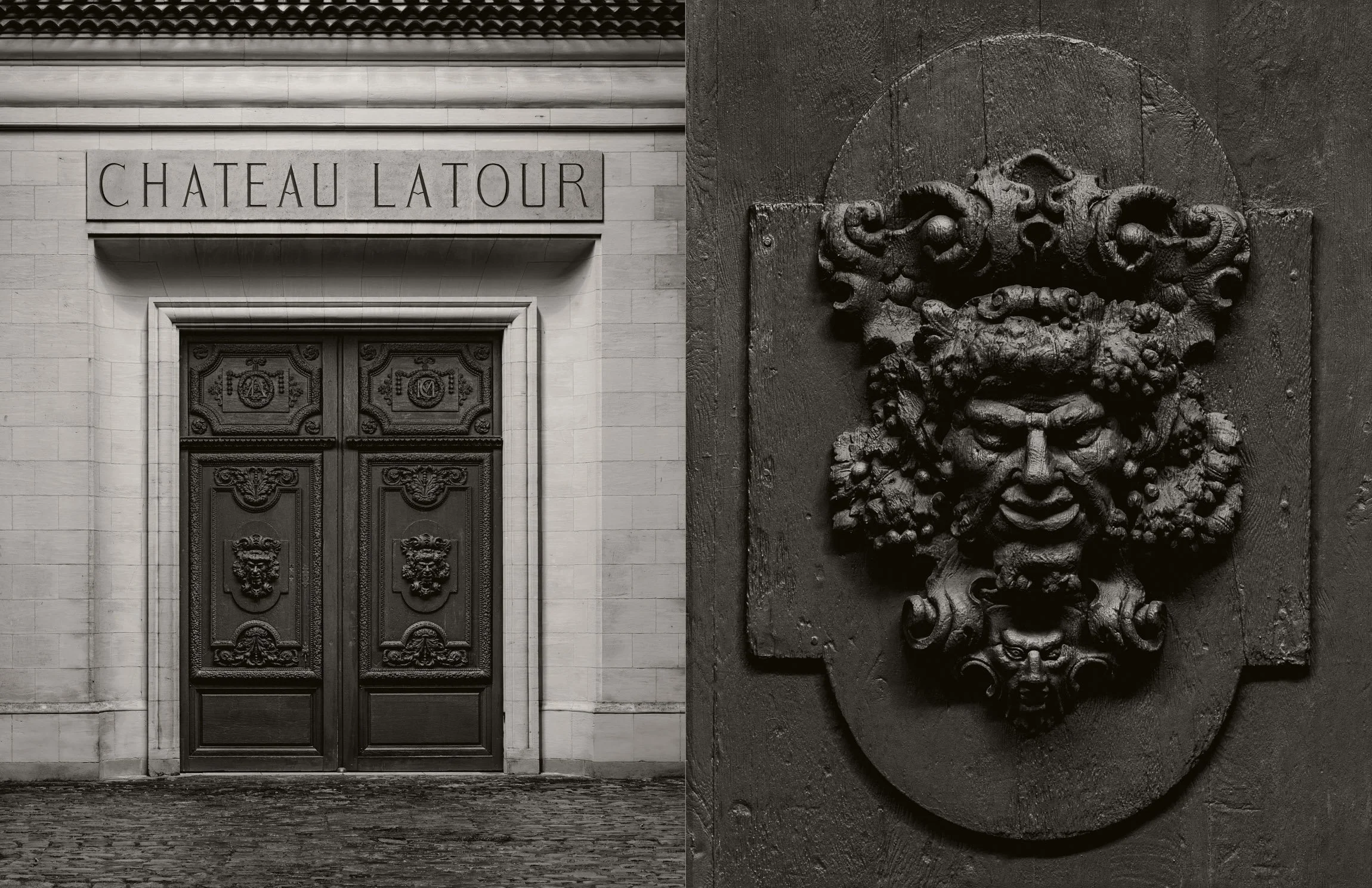
The grand doors of Chateau Latour. Long exposure after dark using drone mounted lighting ⎮ Bacchus carving
I wanted to bring every aspect of my practice to Latour. When I’d been planning shots I had hoped that maybe there would be a huge pile of prunings that I may be able to do something with. It turned out that the workers leave the prunings in small piles in between the rows of vines. They will eventually be collected and mulched, but at the time of my visit these are still on the ground. Once I knew that I had enough shots in the bag I take an afternoon to build a figure from these remnants. I’d bought almost all of my gear from home in my van, knives, my axe, cordage and some willow staves that I thought might come in handy, these formed cross braces and stability for the more chaotic, twisting vines. Intrigued pruning workers stop and look on, I try to explain in broken French, showing them images of my ‘forest figures’. “Vodou!” One guy exclaims. I like to think perhaps it is a personification of Bacchus.
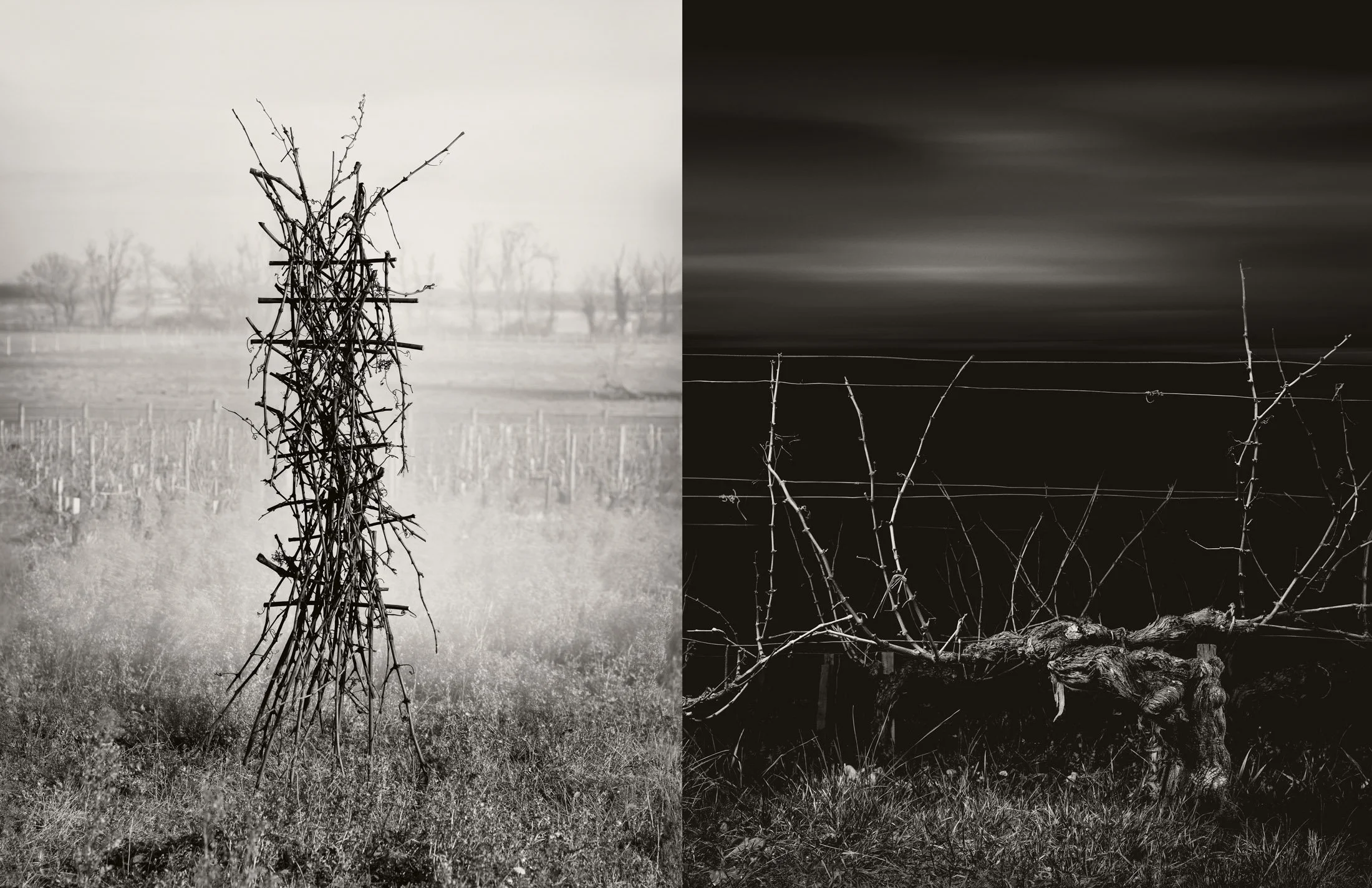
Figure made from vine prunings ⎮ Cabernet vine at night
The day I leave Pauillac the hotel seems very quiet. A breakfast buffet for one is laid out on a small table. I ask the staff at the front desk if I am the only guest still here. ‘Yes,’ they reply, ‘it is almost Christmas. Everyone has gone home.’
I drive north with my precious cargo of images. The weather had been more or less benign, save for one stormy morning, and I had got what I came for. I arrive home on Christmas Eve, to find that Latour has engraved itself onto my psyche – I walk into my back room, which always has a chill in the winter, and I’m immediately taken back to the cold barrel cellars. My anxieties about the weather, having enough to shoot, and finding my creative muse in such a place are all behind me and I can enjoy the editing and construction of the pieces you see above. Applying my creative vision and technical process to such a new subject has been hugely rewarding, the images feel less mine, and more a collaboration between me and the spirit and history of Chateau Latour.
View the full set of images here